
- Details
- Hits: 4331
Station: Grand Marais, MI
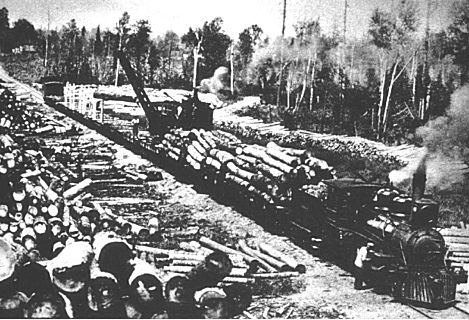 Grand Maris on Lake Superior in Alger County was first noted on early maps in 1660. A permanent settlement began after the Civil War. The village was platted in 1884. The town was the center of logging operations as the forests around Grand Maris were harvested. The Manistique Railway ran north to this town from Schoolcraft county via Seney, providing one round-trip per day.
The town was isolated, being reached only by lake or rail. There was no road before 1920.
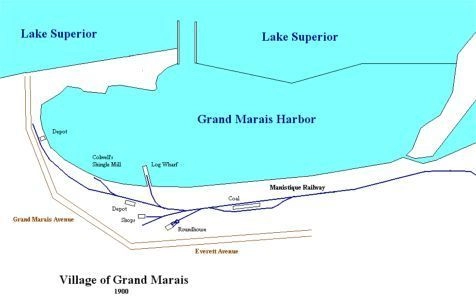
Photo info: Top, a logging train somewhere between Grand Marais and Seney, provided by Gregg Bruff, Park Ranger at the Pictured Rocks National Lakeshore, US Park Service. This photo is located in the Park's museum collection. 2nd image, a map of Grand Marias copied from a 1900 blue print in the State of Michigan Archives, showing how the Manistique Railway entered the town. [Dale Berry].
Notes
Time Line
1889. The village of Grand Marais, Alger County, is greatly wrought up, says a letter from Ishpeming. Supervisor Bogren and two other citizens are in jail on charges of illegal liquor selling, and Schoolmaster Hackett has left the country, a warrant for his arrest on the same charge being out. It seems that selling whiskey on the sly was recognized as a laudable pursuit, but the State law has interfered, and the underpinning of the social fabric has been knocked from under the best society of the village. [NREP-1889-0905]
1893. Manistique Railway main line finished from Camp 10 to Grand Marais [MRL]
1895. The mail from Seney to Grand Marais is still carried by dog sledges (sic) notwithstanding the fact that the Manistique Railway has been completed to the latter place and has a train daily each way. The people are kicking and want the mail sent by train. [CCA-1895-0214]
1910. Present prospects are that the Village of Grand Marais practically will go out of existence as a result of the recent foreclosure sale of the Manistique railway to the Manistique Lumbering Co., holder of the bonds, and the decision of the latter to abandon and dismantle the property. Only a partial train service is being maintained at present, and it is stated that even this will be discontinued at the end of the month. Attempts to induce capital to take over the property have failed. Grand Marais is largely dependent upon the railroad for its supplies and for the shipment of lumber and other products, it is considered to have received its death blow. [UVC-1910-1028]
1910. All lumbering operations cease and the railroad was closed. [TTUP]
1920's. A road was put into operation from Seney to Grand Marias. After the railroad closed in 1910, the only way to reach the town without the railroad was by lake vessel. [TTUP]
Industry
- Cook, Curtis & Miller mill - (1906 → xxxx) - enough timber for 15 years. [AML-1/13/1906]
- Marais Lumber Co. (xxxx ← 1906 → xxxx) - Cuts for the Manistique Lumbering Co. and the Eddy Land Company. Suspends operation in the winter.
Bibliography
The following sources are utilized in this website. [SOURCE-YEAR-MMDD-PG]:
- [AAB| = All Aboard!, by Willis Dunbar, Eerdmans Publishing, Grand Rapids ©1969.
- [AAN] = Alpena Argus newspaper.
- [AARQJ] = American Association of Railroads Quiz Jr. pamphlet. © 1956
- [AATHA] = Ann Arbor Railroad Technical and Historical Association newsletter "The Double A"
- [AB] = Information provided at Michigan History Conference from Andrew Bailey, Port Huron, MI
Contact Us

Email: webmaster@michiganrailroads.com